





Sustainability Has Become the Entry Fee
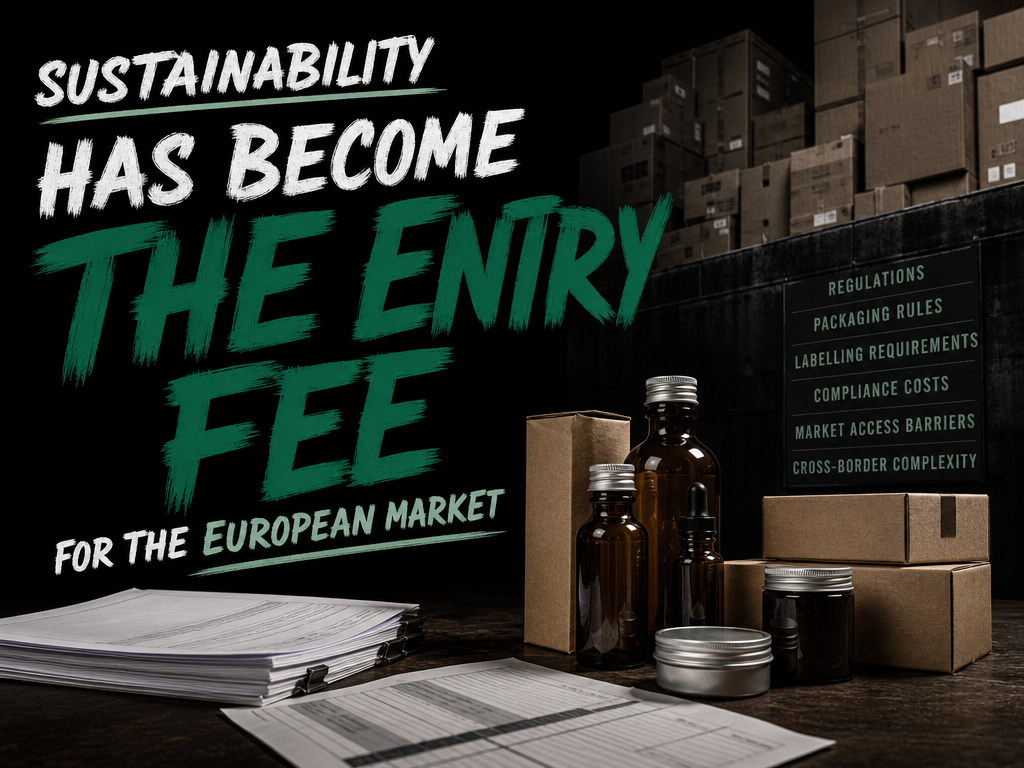
Over the past few weeks, we’ve been dealing with a topic that, a few years ago, I probably never would have imagined would take up so much time when building a men’s grooming brand: packaging, registrations, and legislation.
On 12 August 2026, the new European Packaging and Packaging Waste Regulation, the PPWR, started to apply. The intention is clear and, fundamentally, a good one: companies should take more responsibility for the packaging they place on the market and, with that, for the waste that packaging eventually creates.
I don’t have a problem with that in itself. Quite the opposite.
I’m personally very environmentally conscious, and from the very beginning we also built MANEFORGE with the idea that we want to handle materials, resources, and packaging as responsibly as possible. Wherever we can, we use glass, cardboard, paper, and aluminium, we reduce unnecessary materials, and we try to think long-term. Not so we can stick a green icon somewhere and write “eco,” but because the amount of greenwashing we’ve seen everywhere in recent years honestly gets on our nerves.
If something is not genuinely more sustainable, then it does not suddenly become more sustainable just because the packaging is green.
So the problem for me is not the idea itself. The problem is the way it is implemented.
For a small niche brand, Slovenia is simply not a big enough market
MANEFORGE is a young and very niche brand. Slovenia is a small market.
If you sell something very general, the story may be different. But if you develop specific products for beard, moustache, and men’s hair care and want to build a serious company around that one day, it is fairly obvious that sooner or later you will also have to look for customers outside Slovenia.
And this is exactly where one of the European Union’s greatest advantages is supposed to come in.
We are one economic area. We talk about the free movement of people, services, and goods. So as an entrepreneur, you logically expect that you can sell from Slovenia to someone in the Netherlands, Belgium, Sweden, Ireland, or Poland without having to open a new administrative chapter in your life for every individual order.
But this is exactly where the problem begins.
When it comes to packaging, the European Union does not have one unified system where you register once as a company and then simply report how much packaging you actually sold into each individual country.
Instead, you have separate national systems.
If you want to sell in several countries, you have to deal with each one individually. Registrations, producer responsibility systems, contracts, reporting, forecasting packaging quantities, and of course costs.
Those costs can vary enormously. In some cases we are talking about a few dozen euros, in others a few hundred, and in some countries the total cost of registration, the system itself, representation, and administration can rise considerably higher.
And that does not even include the packaging itself.
The packaging fees are not even the biggest problem
When it comes to paying for the packaging itself, I actually find the principle quite logical.
If we sell more into a certain country, we bring more packaging into that country, and it is fair that we pay more. If we sell less, we should pay less. If we use cardboard, paper, or glass, the burden may be different than with plastic or other materials.
I understand that, and I would support it myself.
If we send a certain amount of packaging into Germany, MANEFORGE should contribute its share to the handling of that waste in Germany.
Fair enough.
But then we come to the second part: fixed registration, administrative, or licensing costs.
And that is where the logic starts to fall apart for me.
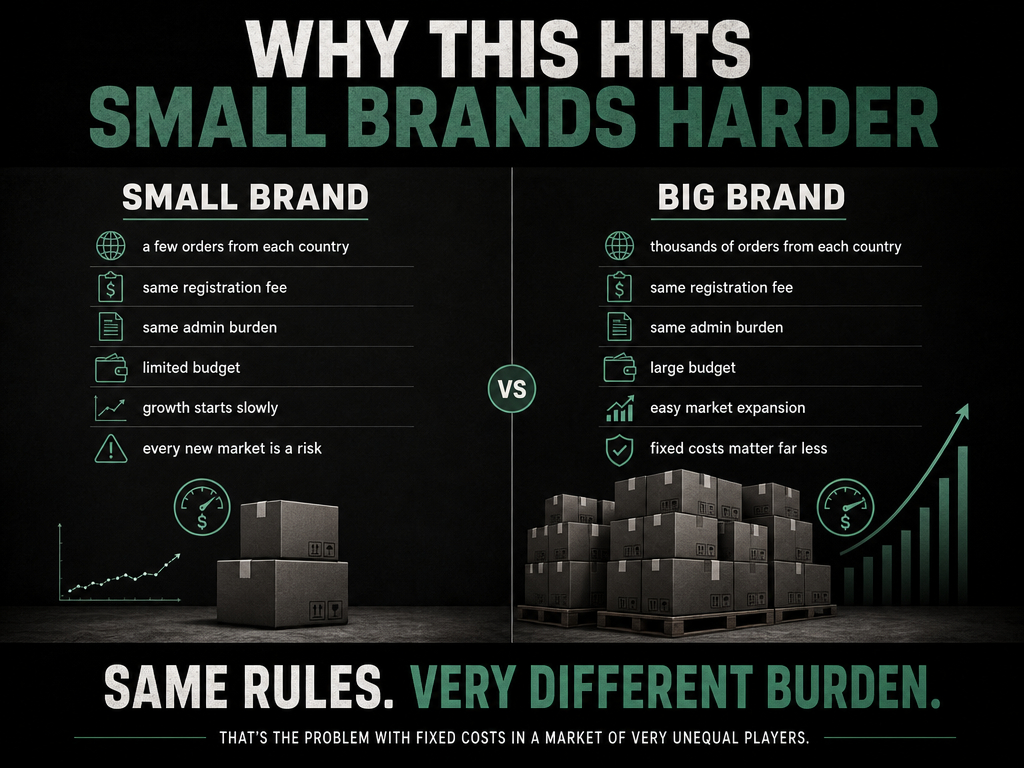
Imagine that MANEFORGE makes a few hundred euros in sales per month in one market. On the other side, there is Brand XYZ with millions in monthly revenue in that same market.
The basic registration or administrative cost can be very similar for both of them, or even exactly the same.
At first glance, someone might say that this is equal treatment.
After all, both pay the same.
I see it in almost the opposite way.
500 euros are not always the same 500 euros.
For a company with millions in revenue, it is one line item. For a microbusiness, it can be a very real part of the entire monthly budget.
If we took a purely hypothetical average of 500 euros per country and multiplied it by the 27 countries of the European Union, we would arrive at 13,500 euros per year.
Just for the possibility of being present in those markets.
Before you have sold a single product.
Before you have paid the actual packaging fee.
Before you have paid for production, warehousing, marketing, translations, shipping, accounting, taxes, and everything else.
Of course, the cost is not 500 euros in every country. In some places it is less, in others more. This is about the principle.
And that principle hits small companies much harder than large ones.
The big get bigger, while the small struggle, fail, and barely survive
This is what bothers me most about the whole thing.
A large brand has a legal department, accountants, compliance people, consultants, and partners in different countries. If a new law comes along, someone in the company reads it, prepares a process, adds the cost to the budget, and life goes on.
With a small brand, the situation looks a little different.
The same person may answer customers in the morning, then check production, solve packaging issues, work on the website, prepare marketing, talk to a supplier, and then in the evening read European packaging legislation and figure out which country they now need to register in as well.
Every new requirement like this is therefore not just a cost. It is additional work, an additional worry, and one more risk factor.
As if there were not already enough of those in entrepreneurship.
And yes, sometimes I genuinely wonder how much influence the interests of the biggest players have in decisions like these. I am not claiming that this law is the result of any specific lobbying, because I don’t know that. But it is very difficult to deny that large companies are able to absorb systems like these much more easily.
That is why I am worried about one very simple outcome.
The big get bigger.
They buy the smaller ones.
There is less and less competition.
And the small ones struggle, fail, and barely survive.
Then we introduce a new system that, on the surface, is aimed at something good, while in practice the biggest players may simply pay the invoice, and the smaller ones begin asking themselves which countries they can even afford to sell into anymore.
For us, the biggest problem is not Germany. It is one order from Ireland.
This is probably the most concrete example of what this actually feels like for us.
Until now, we could have practically the entire European Union available in our webshop.
Then someone in Sweden happens to discover us. Someone in Ireland sees a video. Someone from Belgium or Poland finds our product through Google or through a recommendation.
They place an order.
Maybe only once.
Maybe the following month there will be nobody else from that country.
But maybe that person shows the product to a friend. Then a second order comes. Then a third.
That is organic growth.
That is how a small brand begins to expand in the first place.
You do not attack a new market on day one with a million euros.
First, one order comes in.
Then another.
You listen to people, watch the market, and see whether there is actually something happening there.
But if, for that one order from Ireland, you first have to justify a registration, a contract, and a cost, then that order simply no longer makes sense.
And so it does not happen.
Not because we do not want the customer.
Not because the product is not allowed there.
Not because delivery is impossible.
But because one customer does not justify the entire administration required for that market.
And that is exactly how organic growth gets cut off before it even has a chance to begin.
Maybe that one customer would have turned into a hundred customers within two years.
Now we may never find out.

This is where, in my opinion, the idea of free movement also starts to crack
I am not saying that the free movement of goods legally stops existing.
Of course it still exists.
But for a small business, it starts becoming more and more theoretical.
On paper, you have access to the entire European Union.
In practice, you have to ask yourself how many countries you can financially afford to enter.
For MANEFORGE, this will probably mean that we have to focus more strongly on one, two, or a few key countries.
There, we will pay the registration fees, direct our marketing, and try to grow.
Other countries we may have to restrict.
And I think that is one of the greatest losses of this kind of implementation.
Because it takes away your ability to simply listen to the market first.
To see where people are coming from.
To notice that, for example, something suddenly starts happening in the Netherlands, and only then invest more money there.
Now you almost have to reverse that order.
First, pay.
Then hope the market exists.
A much more logical system would actually be quite simple
If someone asked me how this should work, I would make the system much simpler.
You register once at European level.
You sell throughout the year.
In January of the following year, you report how much you actually sold into each individual country and how much packaging you actually sent there.
Germany this much.
Belgium this much.
Sweden this much.
Ireland this much.
And then you pay.
If each country needs to receive its own share, let it receive its share.
If they have different rates for different materials, fine.
If the reporting needs to be monthly instead of annual, also fine, although that again creates more work.
But let it be based on what actually happened.
Not on the fact that before anything has even happened, you have to predict where you are going to sell, how much you are going to sell, and how much money you need to invest upfront.
If the registration or licensing fees were also proportional to the volume or the size of the company, that would be a completely different system.
I do not know whether that should be based on turnover, packaging volume, or something else.
But some kind of proportionality should exist.
Because the same rule for very different players does not mean the same burden.
To me, business is a bit like an MMA ring with no weight classes
This is the comparison that keeps coming back to me.
Business is like an MMA ring.
Except there are no categories in that ring.
Everyone is together.
50 kilos.
90 kilos.
Beginners.
Professionals.
Children.
Adults.
Everyone competes in the same space.
And then we say everything is fair because the rules are the same.
But imagine that we have a very persistent, stubborn nine-year-old who genuinely wants to win.

On the other side stands a thirty- or forty-year-old, fully trained, 90-kilogram professional fighter.
And the referee says: both of you have the same rules.
Great.
Except one of them practically has no chance.
That is sometimes how being a small brand feels.
MANEFORGE may be that very stubborn nine-year-old.
It will not give up.
It tries to be smart.
It tries to find gaps, opportunities, and ways to survive.
On the other side, you compete with giants that have million-euro marketing budgets, enormous production volumes, much lower purchasing costs, and entire teams of people dealing with things for which we often do not even have one dedicated person.
And I accept that in itself.
That is the market.
I do not expect anyone to tell the biggest companies to become smaller just so life is easier for us.
But then you at least expect legislation not to come along and hit that nine-year-old over the head as well.
Then someone asks why our product is not the cheapest
That is another thing people often do not see.
Why does this product cost so much more than another one?
Why is someone else selling something similar for half the price?
Because there is much more behind a product than what is inside the bottle.
Raw materials.
Development.
Smaller production runs.
Packaging quality.
Production in Europe.
Wages.
Testing.
Regulation.
Taxes.
Logistics.
Compliance.
And now all these additional systems as well.
On the other side, you may be competing with products from countries and supply chains where labour costs are dramatically lower and where, as a consumer, you often have almost no insight into the conditions under which a product was actually made.
Someone can then fill a huge plastic bottle with a very cheap base, synthetic ingredients, and fillers that are mainly there to create volume, and because of massive production runs they can reach manufacturing costs we will never be able to match.
At the same time, they may have more money for marketing than our entire brand has for everything in one year.
And we are still in the same ring.
Again, that is part of business.
But that is exactly why additional barriers that are applied equally to everyone, regardless of how big or small they are, are so much harder to accept.
Even sustainability is something you first have to be able to afford
At MANEFORGE, we still have many ideas for how we could do things better.
Take the packaging of our oils, for example.
One idea is that you would receive the pump only with your first purchase. The next time you order the oil, the bottle would come only with a simple aluminium cap, and you would just move the old pump onto the new bottle.
Why manufacture and ship a new pump with every purchase if the old one is still perfectly usable?

It is a small thing.
But even a small thing like that requires capital.
A new type of packaging.
A supplier.
Minimum order quantities.
Testing.
Logistics adjustments.
Graphics.
Possibly a new warehouse process.
And that is exactly what often remains invisible.
A small brand can be very sustainability-minded and have ten ideas about what it wants to improve, but every improvement costs money.
If you have more capital, you do it tomorrow.
If you do not, you have to wait.
And if, in the meantime, you have to spend more and more of that capital on registrations, administration, and new obligations, then perhaps exactly those improvements that would genuinely reduce waste are delayed.
Which, in the end, is quite ironic.
We do not want less responsibility. We just want a little more common sense.
I do not want this article to come across as an attack on environmental legislation.
It is not.
If MANEFORGE brings a certain amount of packaging into a country, it is right that we pay for it.
If a material is more problematic, let it cost more.
If a company creates more waste, let it contribute more.
I have no problem with that.
In fact, I would gladly support such a system.
What bothers me is a system where fixed costs and administration are not sufficiently proportional to the actual impact of the company.
If you have three orders a year in Belgium, you are not the same as a company that sends three million products there.
Both have responsibility.
But that responsibility should not come with the same entry fee.
And if the system worked more according to actual impact, it would be much easier to understand and support.
What are we going to do?
Probably the same thing we always do.
Keep going.
The people behind MANEFORGE are pretty persistent and, without wanting to beat our chests too much, I think we are also fairly capable.
We will find a way through this.
Maybe we will have to focus more strongly on specific markets.
Maybe we will have to close certain countries for sales.
Maybe growth will be slower.
Maybe we will have to spend money on a new registration that we would much rather spend on development or better packaging.
It will not be the first time something comes along and makes things harder.
And probably not the last.
What worries me more is how many small companies will simply reach the point where, with all these additional obligations, they say: this no longer works.
Because then we end up with exactly the opposite of what we should want.
Fewer small brands.
Less competition.
Fewer different ideas.
More space for the biggest players.
The big grow, while the small fail and barely survive.
And that is why we are not asking anyone to protect us from competition.
We are not asking to create waste without consequences.
We are not asking for special privileges.
Just for a little proportionality.
If you sell more, pay more.
If you create more waste, pay more.
If you use a more problematic material, pay more.
That is fair.
But if a small European brand needs a system for one order from Ireland, Sweden, or Belgium that costs significantly more than the order itself, then I think it is completely legitimate to ask whether the implementation may have missed the point a little.
Because the European single market should not only be a market in which goods can theoretically move freely.
It should also be a market in which a small European brand actually has the chance to grow organically.
And if I stick with the MMA comparison:
we do not need anyone to hold our bigger opponent back.
Just do not keep hitting us when we are already on the ground.
Evening thoughts from Elvis.